Security Class
Understand the fundamentals of security classes to streamline and accelerate your asset management.
What is security class?
A Security Class (also known as a class of securities) defines the type and characteristics of a financial instrument issued by an organisation. It groups securities that share the same rights, restrictions, and features.
A security can represent ownership in a corporation as stock, a creditor relationship with a governmental body or corporation as a bond, or rights to ownership as an option.
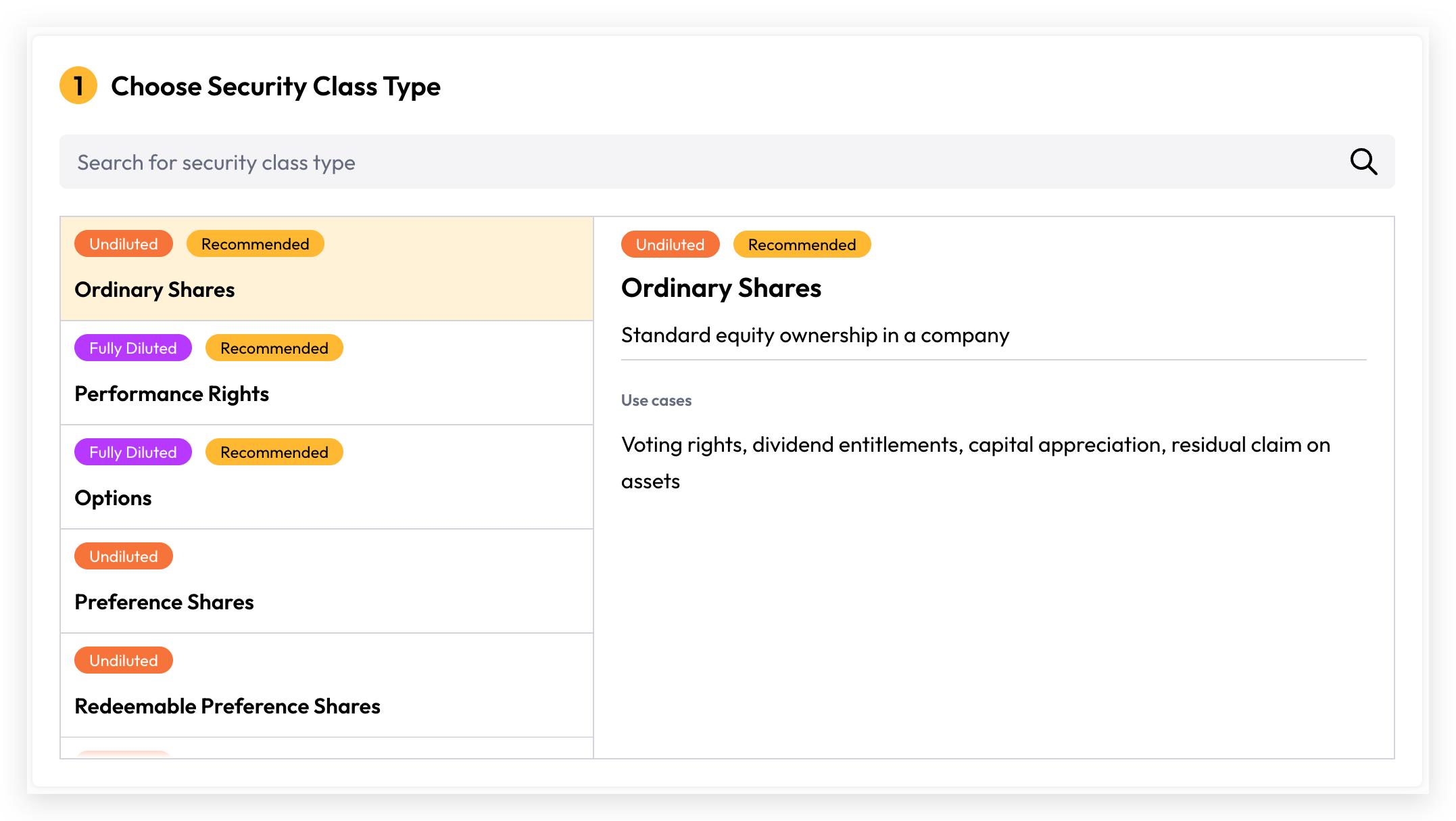
Common examples include:
Ordinary Shares — the most common type, granting voting rights and entitlement to dividends
Preference Shares — typically carry preferential rights to dividends or capital distribution over ordinary shares
Units — commonly used in unit trusts or managed funds, representing a proportional interest in the fund
Options — the right to acquire securities at a specified price within a specified period
Performance Rights — a right to receive shares upon meeting certain performance conditions, commonly used in employee incentive schemes
Convertible Notes — debt instruments that can be converted into equity at a later date
Key attributes that define a security class typically include:
Voting rights
Dividend or distribution entitlements
Liquidation preference
Conversion or redemption rights
Whether it is dilutive or non-dilutive
Where are security classes used?
Security classes are generally applied across the following areas:
Share Registry — Recording and maintaining investor holdings and ownership records.
Cap Table Management — Tracking ownership structure, dilution, and equity distribution across all security types.
Corporate Actions — Processing dividends, distributions, rights issues, and other entitlement events against specific security classes.
Employee Incentive Schemes — Issuing options, performance rights, and other equity-based incentives to employees under defined security classes.
Fundraising & Capital Raising — Issuing new securities to investors during funding rounds, each under a defined class with specific terms and rights.
Regulatory Reporting — Filing and reporting to regulators such as ASIC or the ASX based on the types and quantities of securities on issue.
Why do security classes matter?
Security classes are important because they define the rights, entitlements, and restrictions attached to each type of security issued by an organisation. Here is why they matter:
Legal & Regulatory Compliance — Each security class carries specific legal rights and obligations. Clearly defining them ensures the organisation meets its regulatory and corporate governance requirements.
Investor Clarity — Investors need to understand what they own and what rights they hold. Security classes provide transparency around voting rights, dividend entitlements, and liquidation preferences.
Accurate Record Keeping — A well-defined security class structure ensures that investor holdings, transactions, and balances are recorded accurately and consistently.
Capital Structure Management — Security classes allow organisations to manage complex capital structures, including multiple rounds of funding, employee incentive schemes, and convertible instruments.
Dilution Tracking — Understanding which security classes are dilutive helps organisations and investors model the impact of new issuances on existing ownership percentages.
Corporate Actions — Dividends, distributions, and other entitlement events are processed at the security class level, ensuring the right investors receive the right entitlements.
Reporting & Analytics — Meaningful reporting requires segmentation by security class, enabling organisations to analyse capital movements, investor composition, and ownership trends accurately.
Still need help? Share an idea